Lesson Objective
This lesson introduces the exposure triangle, the foundational framework for understanding how cameras control the amount of light captured in every photograph. By the end of this lesson, you will understand how aperture, shutter speed, and ISO interact to create proper exposure, and how adjusting one element affects the others.
What You Will Learn
- What exposure means and why it matters in photography
- The three components of the exposure triangle and their functions
- How aperture controls light and affects depth of field
- How shutter speed controls light and affects motion
- How ISO controls sensitivity and affects image quality
- The reciprocal relationship between all three elements
Required Knowledge or Tools
Complete Lessons 1 and 2 before beginning this lesson. You will benefit most from having a camera with manual controls available. If your camera only offers automatic modes, you can still follow along conceptually, as understanding these principles helps you interpret your camera's automatic decisions.
Core Concept Explanation
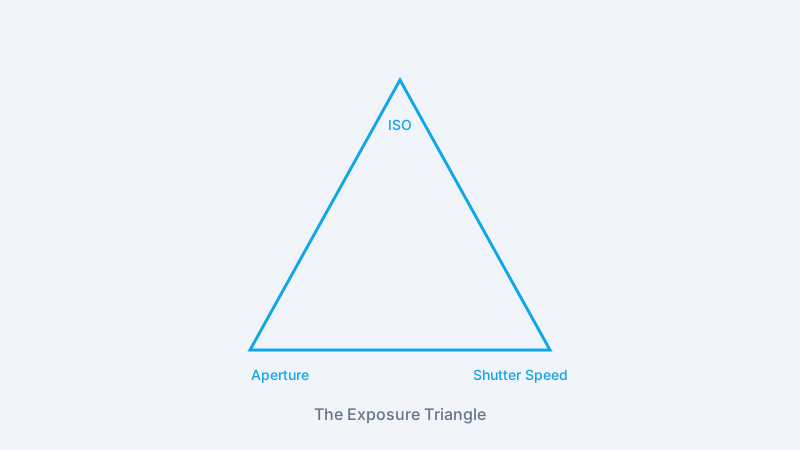
Exposure refers to the amount of light that reaches your camera's sensor when taking a photograph. A properly exposed image shows detail in both bright and dark areas without appearing too bright (overexposed) or too dark (underexposed). The exposure triangle represents the three camera settings that control exposure: aperture, shutter speed, and ISO.
Think of exposure like filling a glass with water. The glass represents your desired exposure. You have three ways to control how quickly the glass fills: the size of the faucet opening (aperture), how long you leave the water running (shutter speed), and how strong the water pressure is (ISO). Achieving the correct exposure requires balancing all three elements.
Aperture: The Size of the Opening
Aperture refers to the adjustable opening in your lens that controls how much light passes through. It is measured in f-stops, with a counterintuitive numbering system: smaller numbers (like f/1.8) represent larger openings that allow more light, while larger numbers (like f/16) represent smaller openings that allow less light.
Beyond controlling light, aperture affects depth of field, which determines how much of your image appears sharp from front to back. Wide apertures (small f-numbers) create shallow depth of field with blurred backgrounds. Narrow apertures (large f-numbers) create deep depth of field with more of the scene in focus.
Shutter Speed: The Duration of Exposure
Shutter speed determines how long your camera's sensor is exposed to light. It is measured in fractions of a second (like 1/250) or full seconds for longer exposures. Faster shutter speeds allow less light but freeze motion. Slower shutter speeds allow more light but can blur moving subjects or cause camera shake.
The creative implications of shutter speed extend beyond exposure. Fast shutter speeds freeze action, capturing sharp images of moving subjects. Slow shutter speeds create motion blur, which can suggest movement or create artistic effects like silky water in waterfall photographs.
ISO: The Sensor's Sensitivity
ISO controls your camera sensor's sensitivity to light. Lower ISO values (like 100 or 200) require more light but produce cleaner images. Higher ISO values (like 3200 or 6400) allow shooting in darker conditions but introduce noise, which appears as grain or colored specks in your images.
Modern cameras handle high ISO settings better than older models, but there is always a trade-off between sensitivity and image quality. Generally, you should use the lowest ISO that allows you to achieve your desired aperture and shutter speed settings.
Why This Lesson Matters
The exposure triangle is arguably the most important technical concept in photography. Every photograph you take involves these three settings, whether you choose them manually or your camera selects them automatically. Understanding this relationship empowers you to predict outcomes, troubleshoot problems, and make creative decisions rather than accepting whatever your camera decides.
When you understand the exposure triangle, you begin seeing trade-offs everywhere. Need a faster shutter speed to freeze action? You must compensate with wider aperture or higher ISO. Want deeper depth of field? You need more light or higher ISO to compensate for the narrower aperture. This understanding transforms photography from guesswork into intentional creation.
Step-by-Step Tutorial
Set Your Camera to Manual Mode
Switch your camera's mode dial to M (Manual). This gives you direct control over aperture, shutter speed, and ISO. Your camera's exposure meter will help guide you, typically showing whether your settings will produce an overexposed, underexposed, or properly exposed image.
Establish a Baseline Exposure
In a well-lit environment, set ISO to 100, aperture to f/8, and adjust shutter speed until your exposure meter indicates proper exposure. Take a photograph and review it. This baseline gives you a reference point for understanding how changes affect the image.
Experiment with Aperture Changes
Without changing anything else, open your aperture to f/4 and observe how the exposure meter indicates overexposure. Now adjust your shutter speed faster until the meter returns to proper exposure. Compare this image to your baseline, noting any differences in depth of field.
Experiment with Shutter Speed Changes
Return to your baseline settings. Now slow your shutter speed and observe the overexposure indication. Compensate by narrowing your aperture or lowering your ISO. Photograph a moving subject at different shutter speeds to see how motion is affected.
Experiment with ISO Changes
In a dimmer environment, try maintaining your aperture and shutter speed while increasing ISO. Observe how higher ISO allows proper exposure in less light. Examine your images at 100% magnification to see noise levels at different ISO settings.
Common Mistakes and Misunderstandings
F-Stop Number Confusion
The f-stop numbering system confuses many beginners because larger numbers mean smaller openings. Remember: f/2.8 lets in more light than f/11. Think of the f-number as a fraction, where f/2 (1/2) is larger than f/8 (1/8).
Ignoring the Trade-offs
Each exposure setting has secondary effects beyond light control. Changing one setting to fix exposure may introduce unwanted effects elsewhere. Always consider depth of field when adjusting aperture, motion blur when adjusting shutter speed, and noise when adjusting ISO.
Seeking One Correct Setting
There is rarely one correct exposure for a scene. Different combinations of settings yield the same exposure but with different creative characteristics. The same scene might be photographed with shallow or deep depth of field, frozen or blurred motion, each approach being valid depending on your creative intent.
Practical Example or Scenario
Consider photographing a child playing in a park on a sunny afternoon. Your camera's meter suggests settings of f/8, 1/250s, and ISO 100 for proper exposure. But the child is running, and 1/250s might not freeze their motion completely, resulting in slight blur.
To freeze the action better, you decide to use 1/1000s instead. This faster shutter speed lets in two stops less light, so your image would be severely underexposed without compensation. You have two options: open your aperture from f/8 to f/4 (allowing more light through a larger opening) or increase ISO from 100 to 400 (making the sensor more sensitive).
If you choose to open the aperture, you trade deeper depth of field for the faster shutter speed. The background might become more blurred. If you choose to increase ISO, you maintain depth of field but accept slightly more noise. There is no wrong answer; your choice depends on which trade-off matters more for your intended image.
Equivalent Exposures
Many different setting combinations produce identical exposure. For example, f/4 at 1/1000s equals f/8 at 1/250s equals f/16 at 1/60s (all at the same ISO). Understanding equivalent exposures lets you choose settings based on creative needs rather than exposure requirements alone.
Lesson Summary
- Exposure is the amount of light captured by your sensor to create an image
- The exposure triangle consists of aperture, shutter speed, and ISO
- Aperture controls light and depth of field; wider apertures (lower f-numbers) allow more light
- Shutter speed controls light and motion; faster speeds freeze action
- ISO controls sensitivity; higher values allow shooting in less light but increase noise
- Changing one setting requires compensating with others to maintain exposure
- Multiple setting combinations can achieve equivalent exposure with different creative effects